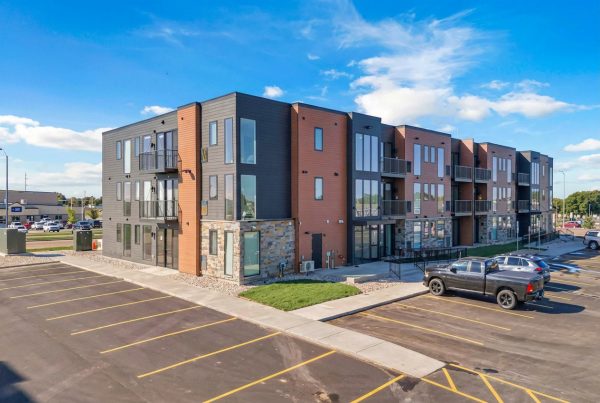
For investors evaluating multifamily capital deployment, Sioux Falls, South Dakota, with a metro population of roughly 300,000, typically fails initial screening based on size. However, the market has produced steady 2.5% annual rent growth for four decades, near-zero bad debt across its rental stock, and development economics that are difficult to replicate in larger metros. This consistency stands in contrast to Sun Belt and Southern markets that have recently faced oversupply and stalling absorption.
The bad debt picture is particularly striking. In distressed urban markets, bad debt can reach 30 to 40 percent of gross potential rent, but in Sioux Falls workforce housing, operators report bad debt at or near zero. Rare missed payments resolve within a month, with no extended delinquency cycles. Dusten Hendrickson, a Sioux Falls-based apartment developer who has delivered more than 1,300 units over nearly two decades, notes, “There’s almost no bad debt here. People feel like they should pay the rent. That’s not something you can say about a lot of markets.”
Sioux Falls sits at the intersection of I-29 and I-90, a factor Hendrickson considers structurally important. “You have to be on an interstate these days. If you’re off the highway, it’s very hard to have growth. Sioux Falls is on two major interstates and it’s close to Minneapolis, Omaha, and Des Moines.”
Three misconceptions keep outside capital from looking seriously at this market. The first is population size. While the MSA reads as sub-institutional, the city’s planning target of 500,000 residents is supported by four decades of uninterrupted population growth. Operators building in the path of that expansion own assets that will be closer to the urban core in ten years. The second is wealth. Sioux Falls is the financial trust capital of the United States, with South Dakota trust law allowing perpetual trusts, drawing financial firms and high-net-worth individuals. Wealth is understated. “People here go out of their way to buy a car that fits in with everyone else’s,” Hendrickson observes. “If they have money, they don’t show it off. But the wealth is here.” The third is education. The workforce is highly educated, with income levels above what market size suggests, and a strong civic culture around financial obligations.
The development economics are compelling. A new ground-up workforce housing unit can be built for approximately $160,000 and commands $1,200 to $1,500 per month in rent, producing a cost basis and rent coverage ratio difficult to achieve in primary markets or Sun Belt metros. South Dakota is a right-to-work state with no income tax, landlord-friendly statutes, and minimal permitting friction. For developers and investors accustomed to regulatory complexity elsewhere, the operational environment is a material advantage.
Mailbox Money Real Estate has been developing ground-up workforce housing in Sioux Falls and surrounding Midwest markets. Projects have refinanced ahead of underwritten timelines, in some cases at three years against a projected five, and economic occupancy has consistently outperformed initial models. A full overview of completed projects is available at mailboxmoneyre.com/portfolio.
Sioux Falls is not without risk. Cold winters are real, and the population base is not large by institutional standards. Investors needing liquidity or targeting short-term appreciation will find better-suited markets elsewhere. For those evaluating stable, predictable performance over a full cycle, the combination of consistent rent growth, near-zero bad debt, below-replacement-cost construction economics, and a landlord-friendly regulatory environment makes Sioux Falls worth examining more carefully than most institutional screens currently allow.

This news story relied on content distributed by Keycrew.co. Blockchain Registration, Verification & Enhancement provided by NewsRamp™. The source URL for this press release is Sioux Falls, South Dakota: A Resilient Rental Market That Defies Institutional Screens.