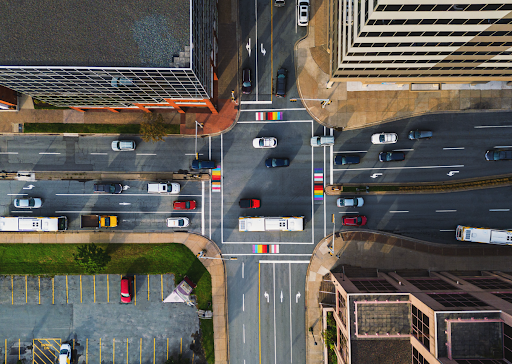
Houston drivers spend more time stuck in traffic and dodging risk than almost anyone else in Texas. Local business owners feel it too. Deliveries get delayed. Employees show up late and shaken after a near miss on the drive-in. Customers cancel appointments because a wreck backed up traffic for miles.
The intersections where these crashes cluster are not random. They follow a pattern, and the pattern says a lot about how this city grew faster than its roads could keep up.
Which Houston intersections see the most crashes?
Crash data collected through TxDOT’s Crash Records Information System points to a handful of repeat offenders. Bissonnet Street and Beltway 8 in southwest Houston have ranked near the top of local crash lists for years, with well over 200 reported crashes in a single reporting cycle. Westheimer Road and Sam Houston Parkway show a similar pattern, driven by heavy retail traffic mixing with feeder road speeds that often top 50 mph. FM 1960, Highway 6, and stretches of the 610 Loop round out the list of chronic hot spots.
Why do these specific spots keep showing up?
Urban planners call roads like these “stroads,” a hybrid of a street and a road that tries to do both jobs at once. A stroad moves fast traffic while also serving retail driveways, left turns, and pedestrians crossing to bus stops. That mismatch creates a huge speed gap between vehicles sharing the same lane. A car braking to turn into a shopping center sits inches from another car doing 50 mph. One distracted second is enough to turn a fender bender into a life-changing injury.
A few factors show up again and again in the data.
- Inadequate surveillance, meaning a driver simply did not look before proceeding through a gap in traffic.
- Failure to yield the right of way at a light or stop sign.
- Speeding to beat a yellow light on a feeder road.
- Distraction from a phone or an in-car screen during the final seconds before impact.
Intersections make up close to 40 percent of all reported crashes in Houston. That number has held steady for years despite new signal timing programs and the city’s Vision Zero initiative, which set a goal of eliminating traffic deaths by 2030. The gap between that goal and the current numbers shows how far a fast-growing road system can outpace policy.
What does this mean for local businesses?
Any business near a chronic hot spot feels the ripple effect. Insurance premiums for company vehicles climb. Delivery windows shrink because drivers build in extra buffer time around known trouble spots. Employees who commute through these intersections daily carry a level of risk that follows them home, not just to the office. A single serious crash can take an employee out of work for months, straining a small business that cannot easily absorb the gap.
What should a driver do after a crash at one of these intersections?
Documentation matters more at high-crash locations because insurance companies expect disputes there. Many of these intersections have nearby traffic cameras, and that footage can settle a fault dispute quickly if someone pulls it before it gets overwritten. Photos of the signal, skid marks, and vehicle position help build the record. A police report anchors the timeline. None of that guarantees a fair settlement offer, though. Insurers know these intersections generate volume, and volume gives them leverage to lowball claims they assume drivers will not fight.
People are naturally skeptical when a law firm says it has handled cases like theirs. Anyone can put “results-driven” on a website. The real question is whether a specific verdict backs it up, with a court, a date, and figures. Sutliff & Stout has that kind of record in exactly this type of claim. In Menard County, a driver named Omero Pecina was rear-ended by a large truck. The truck’s insurer argued Pecina caused the collision by following a slow-moving vehicle and offered only $200,000 to settle, disputing both the cause of the crash and the extent of his injuries. The firm took the case to trial. A jury returned a verdict of $2,168,000 in February 2022, and Pecina’s net recovery came to $1,311,726 after the insurer’s prior medical payment credit was applied.
That is the kind of documented outcome that separates a marketing claim from an actual track record. It’s exactly the kind of dispute, over who caused the collision and how much the injury is really worth, that plays out at Houston’s worst intersections every year.
That track record matters most at intersections like the ones above, where fault disputes are common, and insurers count on drivers giving up before trial becomes a real option.
How can Houston reduce crashes at these intersections long-term?
Longer-term fixes exist, and some are already underway. Protected left turn signals cut down on the failure-to-yield crashes that dominate intersection data. Better lighting reduces nighttime pedestrian crashes near retail corridors. Lower speed limits on streets, paired with real enforcement, narrow the speed gap that makes these roads dangerous in the first place. The Houston-Galveston Area Council continues to study which fixes move the needle fastest, but change on this scale takes years to show up in citywide numbers.
Until then, the intersections above will keep generating a disproportionate share of Houston’s serious crashes. Anyone who drives through them regularly, whether commuting to work or running a delivery route for a local business, should treat the risk as documented fact rather than a vague feeling about bad traffic.
What happens after the crash often depends on the preparation before it
Drivers who know which intersections carry the highest risk can adjust routes, build in extra following distance, and stay more alert through known hot spots. That does not eliminate risk on roads shared with distracted or reckless drivers, but it narrows the odds. When a crash does happen at one of these locations, the difference between a fair settlement and a lowball offer often comes down to whether the driver and the attorney representing them are willing to take the case all the way to trial instead of settling for whatever number an insurer puts on the table first.
Houston’s traffic problem is not going away soon, and neither is the pressure these intersections put on daily commutes and local business operations. Understanding the pattern behind the crash data is the first step toward navigating it more safely.