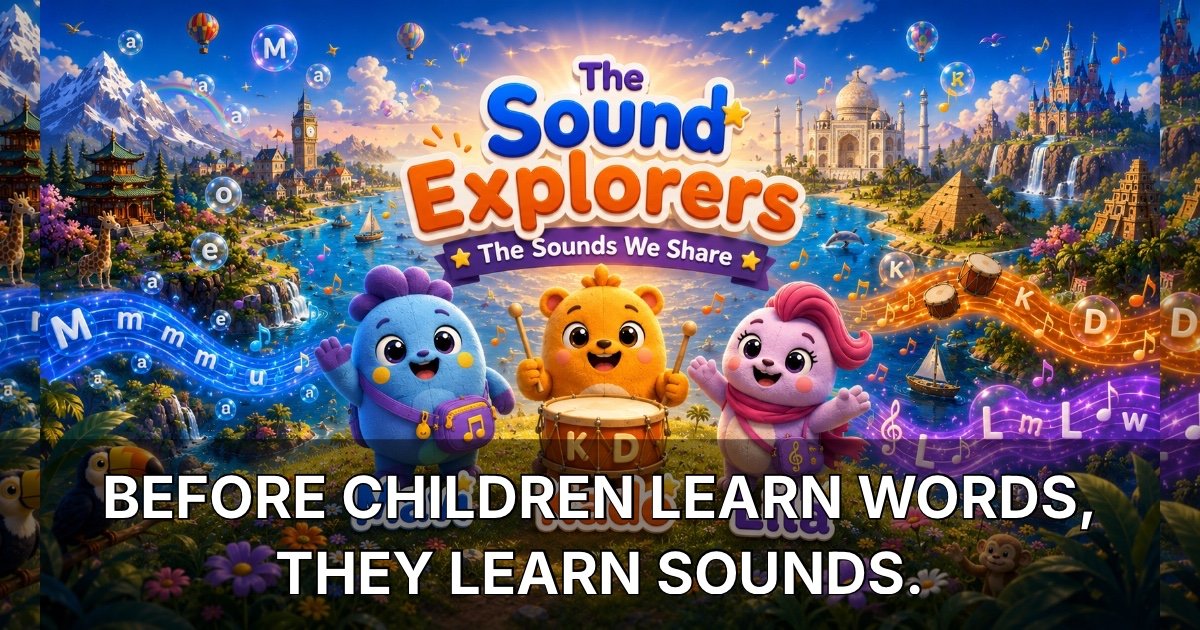
A new children’s music channel, The Sounds We Share, launched this week with a unique approach: songs composed entirely of speech sounds rather than words, designed to be accessible to children regardless of their native language. The channel, available at thesoundsweshare.com and on YouTube, aims to create a shared musical experience for children aged 0 to 5 by using sounds like hums, pops, and rolls that are common across human languages.
Creator Bryan Eisenberg, a former educator and social worker turned digital marketing pioneer and New York Times bestselling author, said the idea stemmed from his study of phonemes—the universal building blocks of spoken language—at Wizard Academy in Austin, Texas. “Before children learn words, they learn sounds,” Eisenberg said. “Words sometimes divide us. The sounds underneath them belong to everyone.” He noted that the concept was 15 years in the making, waiting for the right technology to bring it to life.
The channel is grounded in research on infant language development. Babies are born able to distinguish the full range of human speech sounds, but during their first year, their brains undergo perceptual narrowing, specializing in the sounds they hear most often. The Sounds We Share aims to tap into that early window, pairing playful speech sounds with simple movements like bouncing, marching, or twirling that families can do together.
Importantly, the channel makes no grand claims about its effects. Its website explicitly states that the songs will not make a child bilingual or smarter. Instead, it promises playful early sound exposure, listening, imitation, and movement. “Families deserve two things kids’ media rarely gives them: honesty about how the content is made and honesty about what it can do,” Eisenberg said.
The channel features three characters: Mavi, a blue Sound Explorer; Kado, an orange Rhythm Explorer; and Lila, a lavender Melody Explorer. Season One includes two collections: Sound Adventures, with daytime energy and movement songs, and Dream Sounds, featuring gentle lullabies incorporating rain, ocean waves, and soft vocal sounds.
The music and animation are produced using AI tools such as Suno and Gemini, then refined by humans. The channel discloses this openly on its website. Each song must pass a test: would a child ask to hear it again, and would a parent survive the tenth replay? Eisenberg said he has been “pleasantly surprised by reactions from parents, kids and even neuroscientist researchers.”
The launch of The Sounds We Share highlights a growing trend in children’s media toward inclusivity and transparency. By removing language barriers, the channel offers a rare opportunity for children worldwide to share the same musical experience. However, parents should not expect any cognitive or linguistic benefits beyond enjoyment. The channel is available now, with a free Family Movement Guide at the website.