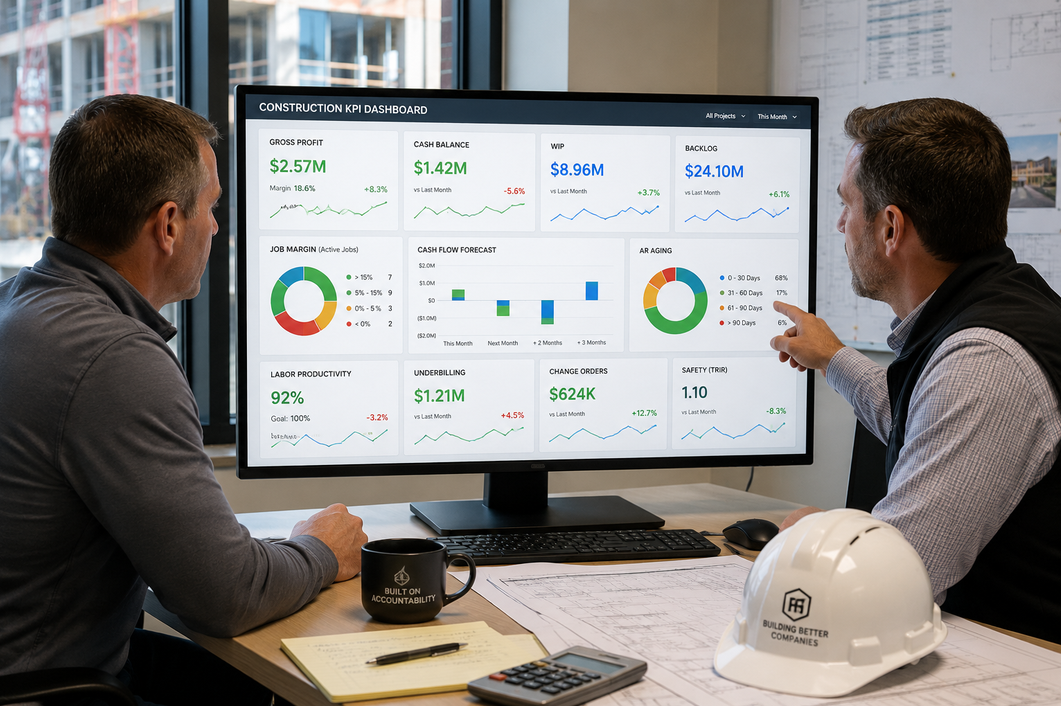
Daaxit, a provider of fractional CFO services for contractors, has released a new educational guide designed to help construction companies transform their key performance indicators (KPIs) into a monthly management scorecard. The resource, published August 3, 2026, aims to address a common challenge: contractors often collect financial and project data but lack a consistent process for reviewing it, assigning responsibility, and taking action.
The guide outlines a structured approach for contractor leadership teams to connect company goals with measurable financial and operational results. It covers a range of indicators, including revenue, gross profit, net profit, EBITDA, cash flow, accounts receivable, debt, and working capital, as well as job-level metrics such as estimated margin, labor productivity, work in progress, underbilling, overbilling, and change orders. By reviewing these measures while projects are still active, leadership can gain a more current view of performance than waiting until jobs are closed.
Aaron Mills, founder and CEO of Daaxit, emphasized that the scorecard is not about adding layers of reporting but about clarifying responsibility. “The purpose is to show what changed, who owns the result, and what action needs to follow during the next review cycle,” he said. The resource recommends assigning an owner to each major KPI and reviewing results on a regular monthly schedule. Financial indicators may be owned by the CFO or finance lead, while operational metrics like labor productivity and change-order status may involve project managers or department leaders.
Daaxit treats cash flow as distinct from reported profit, identifying cash forecasts, receivables aging, retainage, and billing position as key measures that can explain why a profitable contractor might still face liquidity pressure. Similarly, backlog is evaluated separately from total contracted work, with attention to expected margin, labor availability, project timing, and material exposure. This distinction helps leadership teams differentiate between activity and financial strength, as a growing backlog can increase working-capital demands and operational risk if not carefully managed.
The framework is adaptable across contractor business models. General contractors, builders, and specialty trades can tailor the KPIs to their operations. For example, service contractors might emphasize technician productivity and dispatch performance, while project-based contractors might focus more on work in progress and cost to complete. The guide also suggests breaking down performance by division, location, or project manager when company structure requires more detailed analysis.
The full framework is available at Daaxit. Mills describes the process as a management routine rather than a one-time dashboard project, stressing that the value of the scorecard depends on consistent data, regular review, clear explanations of variances, and follow-through on assigned actions. This approach aims to help contractors not only track their numbers but also respond proactively to changes, ultimately improving financial clarity and job-level profitability.