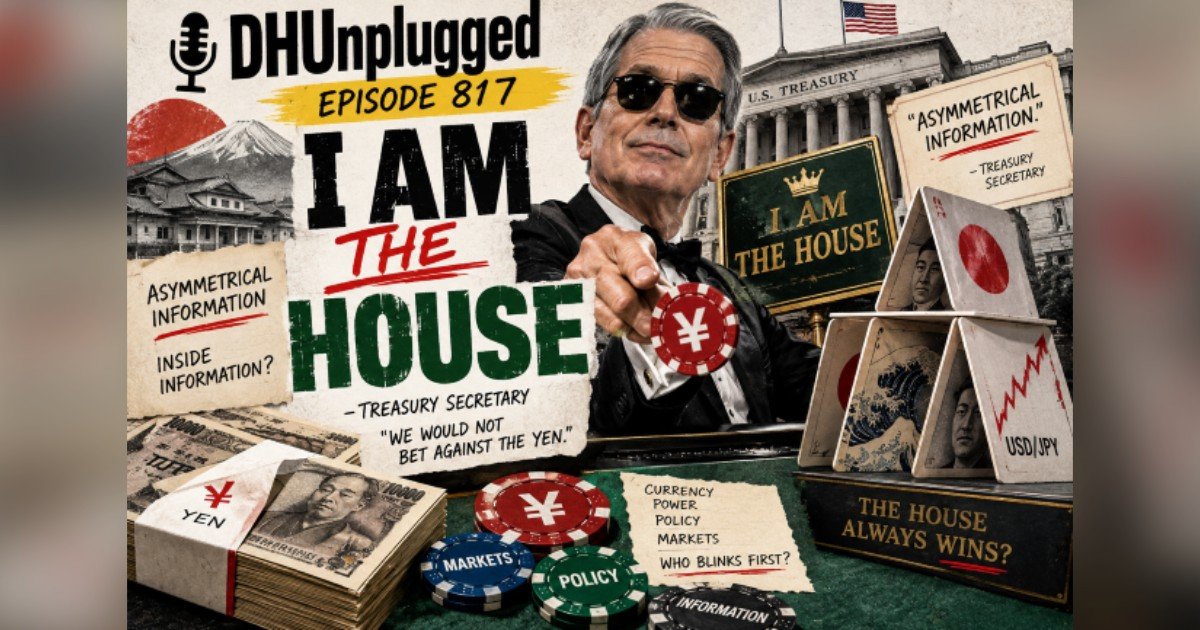
Markets are reeling after a post-Labor Day selloff that saw the Dow plunge more than 600 points, with Treasury Secretary Bessent adding fuel to the fire by openly boasting that he holds inside information on the Japanese yen. The comments, made on the latest episode of the podcast DH Unplugged, have sparked accusations that policymakers are now playing the market as ‘the house,’ a watershed admission that could undermine confidence in the fairness of financial markets.
On the episode titled ‘I Am the House,’ hosted by Andrew Horowitz and JC Dvorak, the hosts dissect Bessent’s remarks, which were made amid rising oil prices and climbing bond yields. Horowitz recounted Bessent’s words, saying, ‘His way of putting this is, I have an edge. And he even said, because I have the information, I have the inside information about what Japan is doing, therefore when I say something, it’s not going to be speculative. It’s going to be absolute.’ Dvorak placed the comment in historical context, arguing that since 2008 the government has increasingly behaved like the Roman Senate before Caesar, and the Trump era has made this dynamic impossible to ignore.
The episode, released September 8, 2026, comes as investors brace for a crucial Consumer Price Index (CPI) print on Friday, which many strategists are calling the ultimate credibility test for the Federal Reserve. The hosts previewed the data, noting that inflation remains a key concern amid a backdrop of rising Treasury yields and a $40 trillion national debt. The 10-year and 30-year Treasury yields have been climbing, putting pressure on equities and raising questions about the sustainability of government borrowing.
Adding to the market unease, the episode also touched on a dead-quiet Strait of Hormuz on AIS trackers, with Goldman Sachs maintaining an oil price target of $120 per barrel. The hosts connected these developments to broader geopolitical risks and their potential impact on inflation and the global economy.
In other news covered, Meta is facing an approximately $18 billion multi-state settlement over youth safety guardrails, a significant legal development for the tech giant. NVIDIA’s reported $13 billion acquisition of Hugging Face was also discussed, a move that JC had predicted a week earlier. The hosts also noted Shein’s downsized Hong Kong IPO, Good Good Golf’s Callaway ad backlash, Nike’s exit from the S&P 500, and a 162,000 payrolls print that offered mixed signals on the labor market.
Horowitz explained his firm’s strategy of buying only short-duration Treasuries, citing the crush of new issuance from Washington and from data center operators tapping capital markets globally. This cautious approach reflects concerns about the bond market’s trajectory as yields rise. The hosts also highlighted strength in Intel, AMD, and SK Hynix ahead of Broadcom earnings, as well as Bloom Energy’s addition to the S&P 500, which sparked sympathy rallies in Oklo and SMR stocks.
The episode’s title, ‘I Am the House,’ encapsulates the growing perception that government officials are using their positions for market advantage. Bessent’s yen comment, in particular, suggests that policymakers are no longer neutral observers but active participants with privileged information. This has profound implications for market integrity and the Federal Reserve’s independence, as investors question whether policy decisions are being made with an eye toward market outcomes rather than economic fundamentals.
As the CPI release approaches, the stakes are high. A hotter-than-expected print could force the Fed to reconsider its rate path, while a cooler number might ease some concerns. But the shadow of Bessent’s remarks looms large, leaving investors to wonder if the rules of the game have fundamentally changed.