For years, businesses have been told to assemble a best-of-breed software stack—buy the top tool for each function and connect them. But according to idhubs, that approach is collapsing under the weight of AI and creating a hidden “integration tax” that drains productivity and resources.
In a recent interview on The Building Texas Show, idhubs Founder and CEO/CTO Rojit Sorokhaibam and Chief Growth Officer Brandon Fears explained why the integration model is fundamentally broken and how their platform aims to replace it. The conversation, which touched on everything from daily operational chaos to enterprise security, highlighted a growing frustration with fragmented systems.
Brandon Fears described the problem vividly: a business with fewer than 200 employees typically runs about 42 separate applications. A manager trying to convert a prospect, send an onboarding agreement, bill a deposit, and assign a kickoff task must touch five different apps, each requiring a separate login. “Multiply that across a week and most of the day goes to running software instead of running the business,” Fears said. Worse, the data across these systems often disagrees, creating a version mismatch that has been sold as “best of breed” for a decade.
Rojit Sorokhaibam argued that AI exposes the fatal flaw in this architecture. When AI was just a chatbot, siloed data was an annoyance. But as AI evolves into agents that execute multi-step work, siloed data becomes an impassable wall. “An agent cannot intelligently complete a workflow if it has to reach across five databases that only pretend to talk through brittle webhooks,” Sorokhaibam said. He calls this “context blindness” and insists that true intelligence requires a single data foundation. “Integrated means two databases that learned to talk. Native means there was only ever one,” added Fears.
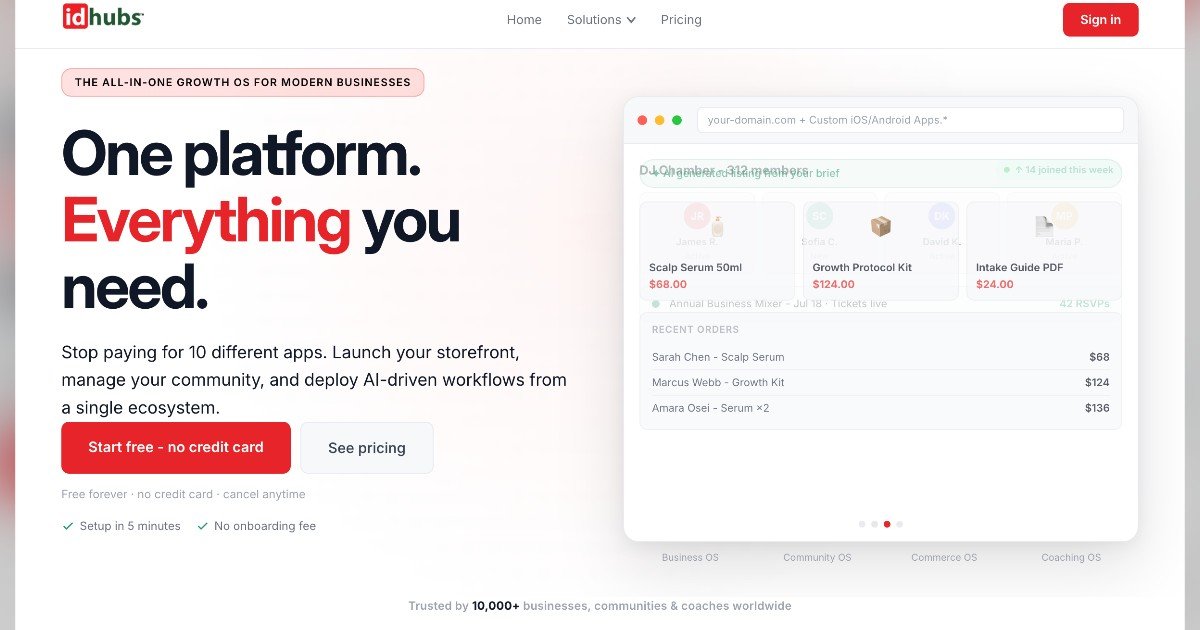
idhubs claims to offer that native foundation: a unified operating system that combines CRM, e-commerce, community, invoicing, and AI on a single shared data layer. The company says it doesn’t just add another tool to the stack—it replaces the stack entirely. For example, in a customer success scenario, an AI agent can read a community complaint, pull billing history from the unified invoicing module, identify a double-charge, auto-draft a credit memo, and route it for approval without any human copying data between tabs.
The platform also includes a white-label community and social commerce layer, allowing organizations to own their audience and data rather than renting it on third-party social platforms. “When you build your community on a third-party social platform, you rent your audience; you don’t own the data, you don’t control the algorithm and you can’t monetize without a cut taken off the top,” Fears said.
Addressing concerns about a single point of failure, Sorokhaibam explained that idhubs runs a permissioned, private Hyperledger Fabric network underneath the platform. This uses channels and private data collections so sensitive records are only visible to authorized parties. “The organization gets the decentralization and immutability of distributed ledger architecture entirely inside its own walls,” he said. He also noted that the ledger anchors state changes and audit trails while heavy files are stored off-chain, ensuring performance isn’t compromised.
The company reports having acquired more than 50,000 registered users organically, with no paid marketing spend, and claims a total addressable market of $158 billion. Its pricing model avoids per-seat fees, instead scaling with organizational capacity and transactional volume. “You don’t get hit with hidden integration fees, per-API-call charges, or forced module upgrades,” Fears said.
For businesses tired of juggling dozens of apps, idhubs presents a compelling alternative: one login, one source of truth, and a secure, AI-ready operating system. As Sorokhaibam put it, “Software stops being a daily operational burden and becomes a silent partner.”