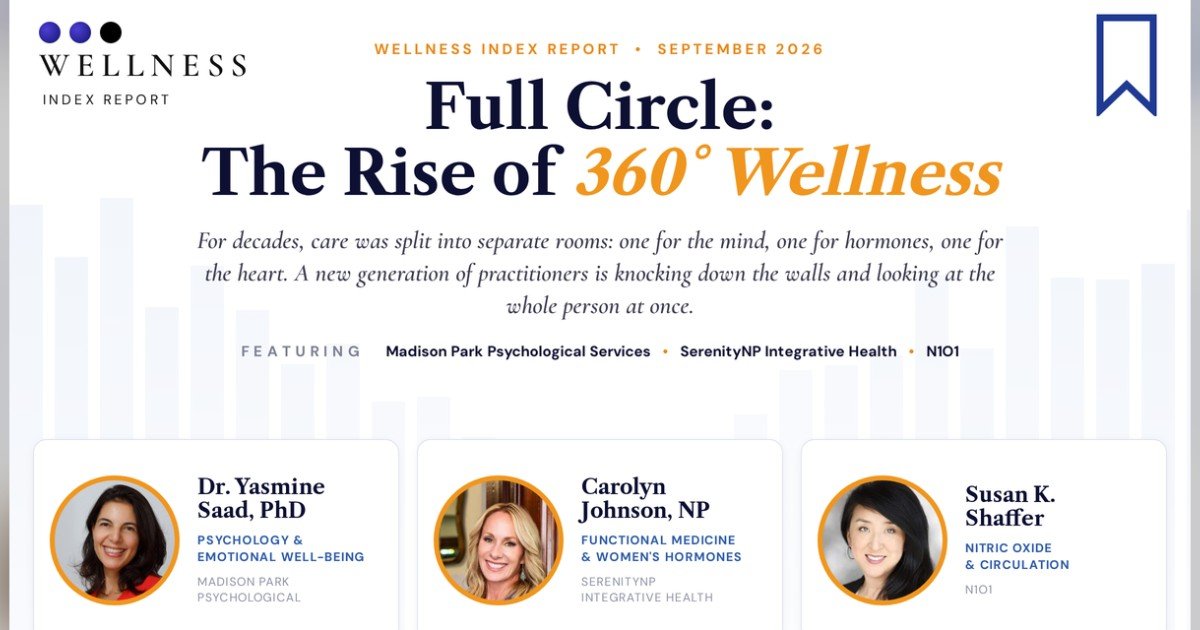
The latest Wellness Index Report, published by Wellness Eternal, finds a clear turn toward whole-person care. For decades, health was split into separate rooms: one for the mind, one for hormones, one for the heart. A new generation of practitioners is knocking down those walls and looking at the whole person at once. September closed with World Heart Day on the 29th, a reminder that well-being has never lived in just one part of the body. The question, the report notes, is no longer which specialist to see. It is who is connecting the dots.
Across psychology, functional medicine, and the science of circulation, the same shift is underway. Tired of being passed between specialists, consumers now seek integrated care that views thoughts, hormones, and blood flow as a unified system. This report spotlights three leaders: mind and emotional health, hormones and metabolism, and nitric oxide signaling for system support.
Mental and emotional health is no longer an add-on to wellness; it is the starting point. People are looking for approaches that go beyond coping strategies to understand what their thoughts and emotions are actually telling them, and they want that work woven into the rest of their health, not kept in a separate file. Women in midlife are pushing back on rushed appointments and “your labs are normal” answers. Demand is growing for root-cause, functional care that combines advanced testing, hormone support, nutrition, and lifestyle, delivered by practitioners who take the time to listen to the whole story. Blood flow sustains each system, brain to skin, and nitric oxide is the key molecule driving this process. As awareness grows that the body produces less of it with age, consumers are turning to hormone-free ways to support their own production as a foundation for whole-body wellness.
Featured voices include Madison Park Psychological Services, led by Dr. Yasmine Saad, PhD, known as “The Wise Psychologist.” A TEDx speaker and internationally acclaimed psychologist whom USA Today called a “visionary” who is “redefining how we understand the human mind,” she founded a multicultural, multilingual team in New York City named to the Inc. 5000 list in 2024. Her signature Inner Message Approach bridges western psychology and eastern philosophy, treating thoughts and emotions as messages to be decoded rather than symptoms to be silenced. Her book, Decode Your Thoughts and Emotions, is due in 2026.
SerenityNP Integrative Health, led by Carolyn Johnson, NP, focuses on functional medicine and women’s hormones in Crystal Lake, Illinois. With nearly two decades of clinical experience, she bridges conventional medicine and root-cause care, focusing on hormones, metabolism, gut health, and whole-body resilience. Her message is simple: “Being heard changes everything.”
N1O1 (Nitric Oxide and Circulation, Richland Hills, Texas). Co-founder and President Susan K. Shaffer brings more than 30 years of corporate leadership to nitric oxide. She co-founded N1O1 with Dr. Nathan S. Bryan, a nitric oxide researcher of more than 30 years and the inventor behind Superbeets and Neo40. N1O1’s hormone-free lozenges dissolve on the tongue in five to six minutes and are formulated to support the body’s own nitric oxide production. “N1O1’s advancements open the door to a vast array of applications that will improve the quality of life for millions of people for years to come,” said Shaffer.
“Real wellness is never one thing. It is the mind, the hormones, and the systems that connect them, all being heard at the same time,” said Lindsay O’Neill-O’Keefe, Founder of Wellness Eternal and host of the Wellness Index Report Podcast. “When care finally sees the whole person, people stop feeling like a collection of symptoms and start feeling like themselves.” Whether through decoding the messages inside our thoughts and emotions, root-cause care that gives women’s hormones the attention they deserve, or hormone-free support for the nitric oxide that keeps every system supplied, Dr. Yasmine Saad, Carolyn Johnson, and Susan Shaffer are pointing at the same conclusion. Wellness is not a list of separate parts. It is a circle, and every part of it matters. Whole people deserve whole care.