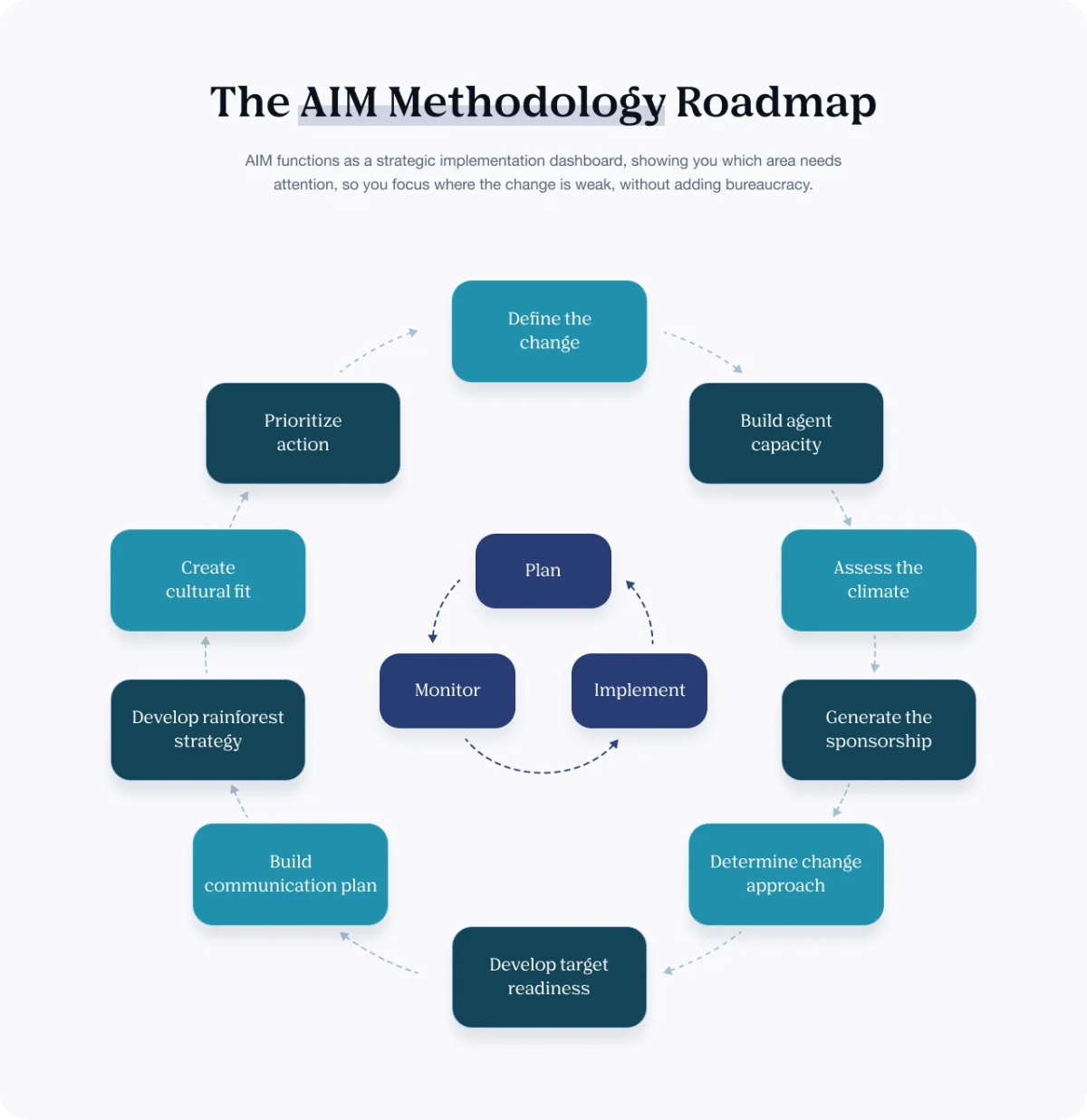
Enterprise AI projects routinely meet their technical milestones, but a persistent adoption gap often leaves employee workflows unchanged weeks or months after go-live. IMA Worldwide, a firm specializing in organizational change, is directing its Accelerating Implementation Methodology (AIM) at this problem, arguing that most organizations underestimate the distinction between technical installation and genuine human adoption.
According to McKinsey research cited by IMA Worldwide, roughly 70% of organizational transformations fail to achieve their goals, take too long, or fail to sustain gains. AI rollouts follow a similar pattern: the technology performs as designed, but the people layer does not. IMA Worldwide draws a clear line between installation—when a system becomes operational—and implementation, the sustained period during which employees adopt new behaviors and integrate new tools into daily work. In many enterprise AI programs, significant investment goes into installation, while implementation receives limited structured support.
The Accelerating Implementation Methodology (AIM), developed by Don Harrison over more than 40 years of field research, treats change as a system that must be actively managed with defined roles, measurable reinforcement, and accountability structures. A central element relevant to AI adoption is executive sponsorship. IMA Worldwide emphasizes that sponsorship is not ceremonial; executives must express commitment, model new behaviors, and reinforce adoption by adjusting systems and incentives. This is referred to as the Express, Model, Reinforce (EMR) ratio, a framework for evaluating whether leadership behavior drives adoption or merely endorses it from a distance.
When the EMR ratio is out of balance, employees receive mixed signals. A leader may express support for an AI tool in a town hall while continuing to request outputs in formats that bypass it entirely. That inconsistency communicates more than any formal message, and AIM identifies closing that gap as a leadership accountability issue.
IMA Worldwide’s application of AIM to enterprise AI programs focuses on building a sponsorship cascade, where senior executives own the strategic rationale and cannot delegate adoption entirely to project teams or IT departments. Commitment must be actively demonstrated and reinforced at each layer of the organization, from senior leadership through middle management to frontline employees. This structure is particularly important in AI deployments because behavioral changes are often fundamental—employees are asked to change how they make decisions, verify information, and define professional contributions. Without active leadership reinforcement grounded in a methodology like AIM, those shifts rarely become durable.
For more information, visit IMA Worldwide.