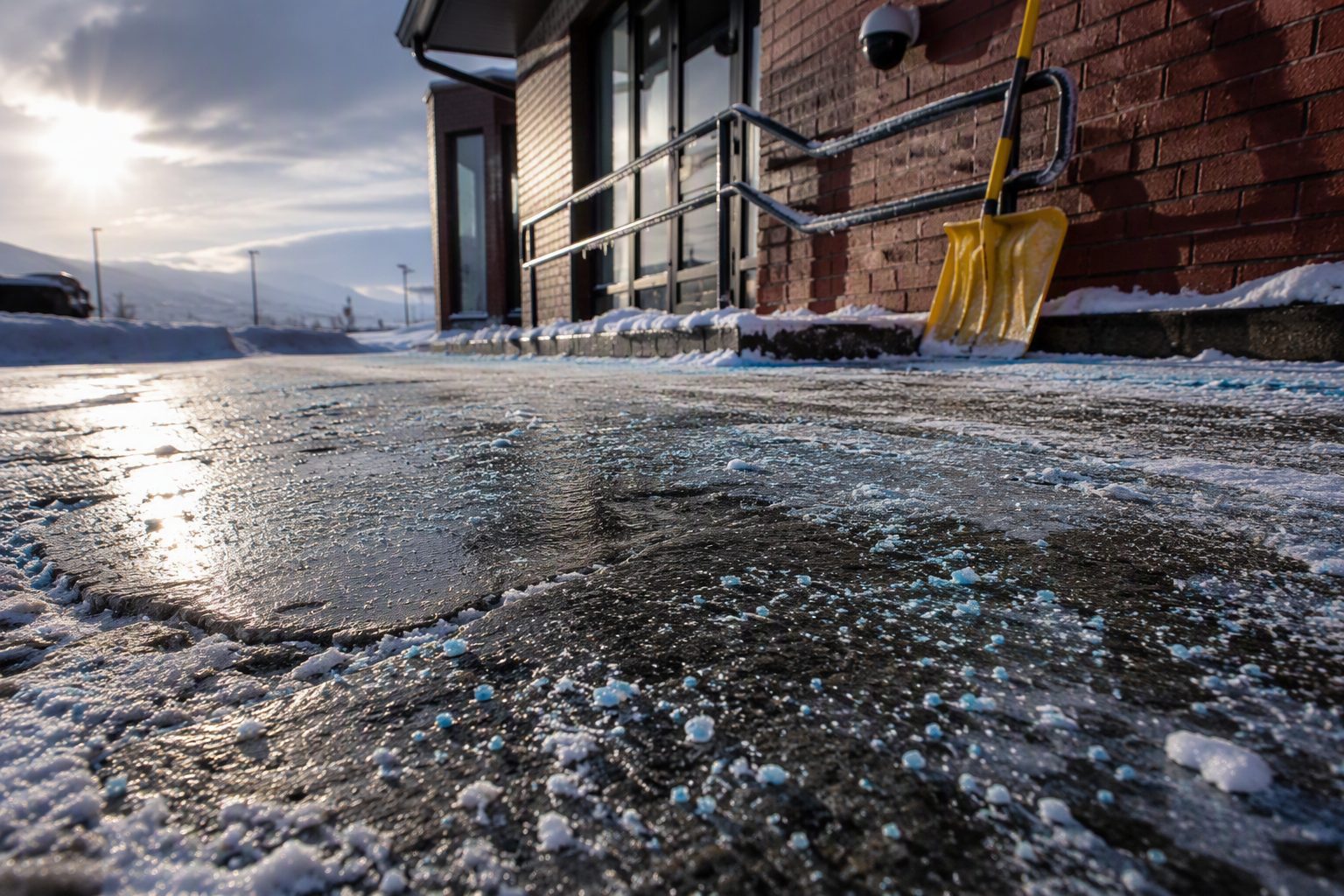
An overnight freeze glazes a shared parking lot off a busy Anchorage road. By 7 a.m., a customer goes down hard on the pavement between two storefronts. Four businesses use that lot. Only one name sits above the door she was walking toward.
The name on the sign isn’t automatically the responsible party. Liability tends to follow control: whoever held that ground and unreasonably failed to clear it or warn about it. Depending on the duties each one took on, that can mean the operating business, the building owner, a commercial landlord, the property manager, or the snow-removal contractor. That is the starting point for slip and fall liability in an Anchorage ice case.
Responsibility turns on records, not on who holds the deed. A lease clause or a sanding dispatch time can point somewhere the storefront sign never suggested.
Who Can Be Responsible for Ice Outside an Anchorage Business?
Ownership and control are related. They aren’t the same thing. A commercial tenant may control its own entrance and steps while the landlord keeps the shared lot, and a property manager may be the one running winter inspections. The contractor may have accepted specific ice duties in writing. That is why determining who is liable for a slip and fall on icy property in Anchorage can put four separate sets of records, held by four different companies, in play at once, and none of them sit in the same filing cabinet.
Alaska applies a reasonable-care standard instead of rigid visitor categories. In Webb v. City and Borough of Sitka, 561 P.2d 731 (Alaska 1977), the Alaska Supreme Court dropped the old licensee and invitee labels and asked instead whether a land possessor acted reasonably under the circumstances. The question stops being what category of visitor you were. It becomes what a reasonable possessor would have done about that ice, at that hour.
Owning the lot doesn’t make anyone liable, and neither does signing a service contract.
| Potential party | Area it may control | Records that could clarify responsibility
|
|---|---|---|
| Operating business | Store entrance, steps, immediate walkway | Opening checklist, incident reports, employee communications |
| Commercial tenant | Leased storefront or tenant-maintained exterior area | Lease, maintenance addendum, inspection records |
| Property owner or landlord | Common walkways, shared parking areas, structural drainage | Lease, property-management agreement, repair records |
| Property manager or maintenance company | Areas assigned for inspection and treatment | Work orders, inspection logs, supply records |
| Snow-removal contractor | Areas and services defined by contract | Service agreement, dispatch logs, treatment records |
How Does Property Owner vs Tenant Slip and Fall Liability Work?
Both can be, and both usually get examined. The lease matters, but so does who was actually out there inspecting and sanding at 6 a.m. The deciding question is whether anyone’s response to a foreseeable freeze fell below reasonable care.
So the owner-versus-tenant question rarely resolves on the first phone call. It gets clearer once someone reads the lease and lines the maintenance records up against what happened on the pavement.
How do control and lease terms affect the analysis?
Lease language often assigns snow removal or common-area maintenance to a specific party. Conduct matters too. If a tenant routinely sanded a walkway the lease never mentioned, that pattern can help show practical control even when the written agreement is disputed.
A lease can also allocate costs or promise indemnity between two businesses. That allocation doesn’t settle an injured visitor’s negligence claim. Contractual responsibility between defendants and tort responsibility to a visitor are related questions. They aren’t the same question.
Picture a small strip mall. The tenant controls its vestibule and entrance mat. The landlord maintains the shared lot, and the property manager schedules the sanding. Then roof drainage refreezes near the tenant’s door and leaves a slick patch that nobody’s paperwork clearly covers. Four parties, one slick patch.
None of that establishes that any of them acted unreasonably. It establishes which files need to come out.
How does snow removal contractor liability for ice work?
It’s possible. A contractor can face liability if it owed a legally recognized duty over the area and performed the work unreasonably by leaving an assigned stretch untreated or by creating a worse condition than it found. Getting hired to plow doesn’t prove liability on its own.
How that duty reaches a visitor who never signed the contract is fact-specific in Alaska. Check it against Alaska authority rather than general commentary or another state’s rule.
The contract file often helps clarify it. Two terms do most of the work: the scope of service and the snowfall depth that triggers a dispatch. Whether ice treatment was included at all is worth checking separately, since plowing and sanding are not the same job. Timestamps showing when crews actually arrived can matter as much as the signed agreement, and so can completion photographs and any record of prior complaints about the same stretch of pavement.
What Do You Have to Prove, and Why Is It Hard?
You need a duty that reached the ground where you fell and a party that fell short of reasonable care over it. Then you have to connect that failure to the fall, and the fall to harm you can document.
Did anyone know the ice was there?
Two kinds of knowledge come up. Actual notice means the party saw the ice or was told about it. Constructive notice asks whether the condition sat there long enough, or formed predictably enough, that a reasonable inspection would have caught it.
Under the Webb framework, notice works as evidence about conduct rather than as a checkbox that a claim passes or fails.
Timing does a lot of the work here. Ice that formed four minutes before a fall is a different case from a patch a delivery driver photographed at 6 a.m., and that was still untreated at noon. A freezing-rain forecast alone doesn’t prove anyone had a reasonable window to respond.
Why are these cases hard to win?
The condition doesn’t wait around. Ice melts, and new snow covers whatever’s left. Somebody sands the lot an hour after the ambulance pulls out. Meanwhile, the injured person has to tie that vanished patch to one party’s unreasonable conduct. Witnesses scatter. Surveillance systems overwrite themselves on a schedule nobody thinks to ask about until the window has closed.
The hardest version of this claim has nothing to do with how badly someone was hurt. It’s the one where nothing on record identifies who controlled the area or how long the ice sat there. No photograph of the ice, no maintenance log. A claim like that is difficult for anyone to evaluate, including the person who fell.
What Evidence Should You Preserve After Slipping on Ice?
Photograph the exact patch before anyone touches it, then step back and photograph the wider area so the location reads clearly. Contact information for anyone who saw it can be valuable. Ask in writing that surveillance and maintenance records be held, and write down the exact time you went down, because Anchorage ice can look completely different two hours later.
The evidence needed for an icy slip-and-fall claim is most useful when organized by how quickly it disappears.
- Scene evidence: Close and wide photographs of the ice, shot before anyone sands or shovels. Get the lighting and the drainage above it too, since roof runoff explains a lot of Anchorage refreeze.
- Business records: Incident reports and surveillance footage. Inspection logs and maintenance work orders often say more about control than the lease does.
- Weather and timing: The exact minute of the fall, matched against National Weather Service or NOAA records for temperature and precipitation.
- Injury documentation: Prompt medical records and photographs of visible injuries, plus the bills and any work restrictions your provider puts in writing.
- People and property: Contact details for witnesses and for the employees who responded. Keep the footwear and any damaged clothing.
Should you fill out the incident report?
Yes, and ask for a copy before you leave. The report fixes a time and a place in writing, which is exactly what gets disputed months later. Read it before you sign it. Describe what you saw yourself, without guessing how long the ice had been there and without accepting blame for facts you don’t know yet.
A completed report doesn’t prove negligence, and a business that writes one isn’t admitting fault.
How can you preserve surveillance footage?
Figure out which cameras face the area, including the ones on neighboring businesses that never appear in anyone’s incident report. Then ask in writing that the footage be preserved, with a date and a specific time window rather than a request for everything the system holds.
Retention practices differ by system, so nobody can promise how long a particular recorder keeps video. A preservation letter isn’t a court order either. It’s a record of what you asked for and when.
What should you avoid saying to an insurance company?
Speculation is the main risk. Don’t guess at what you can’t remember, and don’t agree that you caused the fall while the facts are still unclear. Be accurate about the injury rather than dramatic about it.
Before you give a recorded statement, find out whose insurer is asking. Your own policy may impose duties that another party’s liability carrier has no claim on, and those two obligations aren’t identical. If the injury is serious, get individual legal advice first.
Can You Recover If You Were Partly at Fault?
Yes. Comparative fault for icy falls in Alaska can reduce recovery. Alaska follows pure comparative fault, which means your share of the blame reduces compensatory damages instead of wiping out the claim. Under AS 09.17.060, a person assigned 25 percent of the fault would generally see compensatory damages cut by 25 percent.
In practice, comparative fault shows up as an argument rather than an established fact. The business will say you walked past a cone or took the untreated shortcut with your phone in your hand. Those are disputed facts for the fact finder to weigh.
Visibility doesn’t automatically end the analysis. Estate of Mickelsen v. North-Wend Foods, Inc., 274 P.3d 119 (Alaska 2012), held that the complaint, liberally construed, stated a cause of action concerning the land possessors’ alleged failure to address a dangerous condition, so the court reversed the dismissal and remanded.
How is fault divided among multiple businesses?
Fault gets divided by percentage. Under AS 09.17.080, the fact finder may allocate a share to each responsible party, so the owner and the tenant and the contractor can each end up with a number of their own, and so can you. Each party generally answers for its allocated percentage rather than covering someone else’s share. Adding names to a complaint doesn’t increase the damages you actually proved.
Say proven compensatory damages come to $100,000. You’re 20 percent at fault, the owner is 50 percent, and the contractor is 30 percent. Your share reduces the available recovery to $80,000, leaving the owner responsible for $50,000 and the contractor for $30,000 in this simplified example.
The arithmetic is the easy part. Insurance limits and collectability sit on top of the math, and a settlement with one defendant can change what’s left.
How Much Is an Icy-Fall Claim Worth?
There’s no standard number for an icy fall. What you recover depends on the losses you prove and on how lasting the injury turns out to be, then gets adjusted by whatever percentage of fault lands on you.
Medical expenses and lost income are the pieces that records establish cleanly. A claim for reduced earning ability needs more than that, including work restrictions and real information about your employment. Non-economic harm, meaning pain and the loss of things you used to enjoy, runs through AS 09.17.010, and the current statutory text is worth reading before you rely on any calculation.
The number in a complaint also isn’t the number anyone collects. Every category of damages has to be supported on its own, and the comparative-fault reduction comes off the end of whatever survives.
What about the highest reported payouts?
Alaska doesn’t publish a ceiling figure that predicts what another icy-fall case is worth. Economic losses vary enormously from one claim to the next, and verdict reports routinely leave out the facts that drove the number or bury the terms behind a confidentiality clause.
A severe injury doesn’t guarantee a large recovery. Without a record of who controlled that ground, the severity of the injury does not establish liability.
What Is the Alaska Slip and Fall Statute of Limitations?
You generally get two years under AS 09.10.070 for a personal injury action. The date the clock starts and any exception that applies depend on your facts, and waiting until the deadline is close is a poor plan regardless, because the evidence tends to vanish long before the statute runs.
People also confuse filing with the steps that come before it. Reporting the fall to the business isn’t filing. Neither is opening an insurance claim or sending a demand letter.
A civil action generally starts when a complaint is filed with the court. An incident report and an adjuster’s negotiations don’t pause the statutory period on their own.
Government entities change the picture. AS 09.65.070 addresses certain actions against incorporated units of local government, and a claim involving a municipality can bring in extra procedures and immunities that never touch a private lot. Don’t treat that statute as governing every claim on public property. A government deadline needs case-specific review under current Alaska law.
What to Do Next After an Anchorage Winter Fall
Liability starts with records, not with the name above the door. Find out who controlled the ground where you fell, and do it before the next thaw takes the proof with it. Documentation from a medical provider and a clear read on your filing deadline are the other two pieces.
If the injury is serious and control of the property is genuinely disputed, individualized advice from a qualified Alaska attorney is worth the call before the filing window narrows.