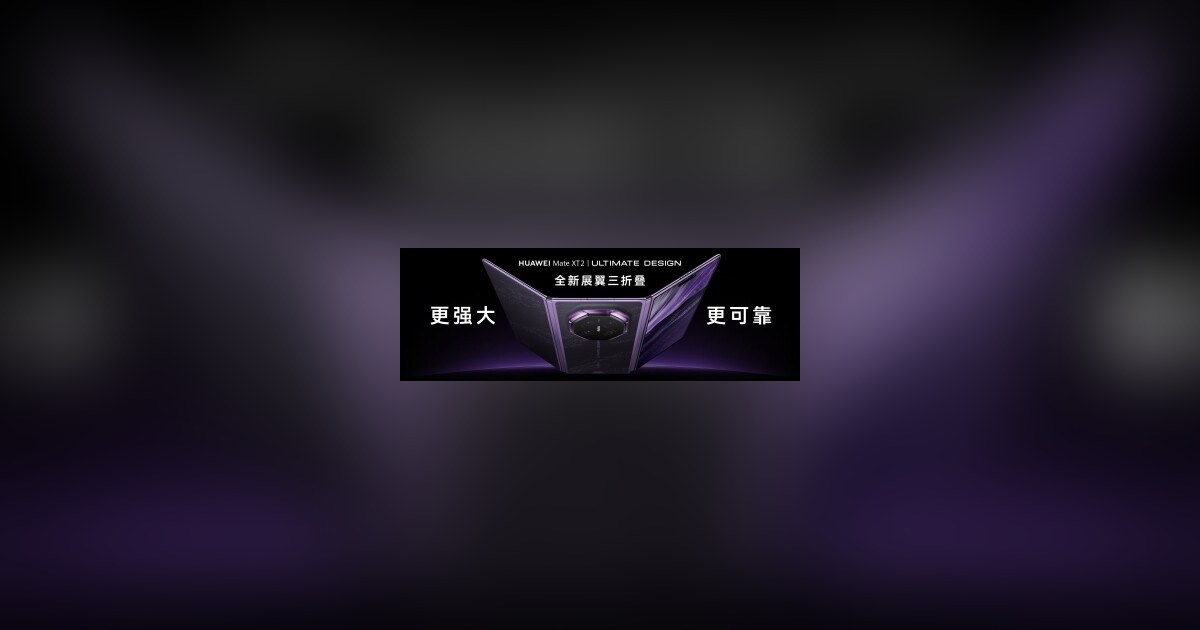
Huawei has released the HUAWEI Mate XT 2 | ULTIMATE DESIGN, a trifold smartphone that the company says is the slimmest and largest foldable in the industry. The device, announced via Media OutReach Newswire, is the first to run HarmonyOS 7 and the first to feature Huawei’s LogicFolding Tau (τ) chip, the Kirin 9050 Pro. The launch signals a potential shift in how semiconductors are designed as traditional scaling reaches its physical limits.
The Mate XT 2’s foldable form allows it to open into a tablet, with a hinge designed to withstand thousands of folds. When unfolded, the handset is just 3.5mm thick. The cover screen spans 6.5 inches, boosting the screen-to-body ratio from 86.4% to 92.8%, and the 10.2-inch main display includes a world-first Smart Shield Privacy Screen that switches from a wide to a narrow viewing angle without losing resolution. The device also introduces industry-first ECG analysis, letting users capture a 30-second ECG by holding both side frames when unfolded, with medically certified software identifying Sinus Rhythm, Atrial Fibrillation, and Premature Beats.
At the core of the Mate XT 2 is the Kirin 9050 Pro, designed by Huawei’s HiSilicon team. It uses LogicFolding, a 3D integration technique that stacks transistors to increase density and reduce the distance data must travel. Transistor density has risen from approximately 155 to 238 million per square millimetre, an increase equivalent to what was achieved in the previous three years using geometric shrinking. This addresses the slowing of Moore’s law, which holds that transistor counts double roughly every two years. Huawei proposes the τ (Tau) Scaling Law, measuring chip performance by time rather than size, as an alternative. He Tingbo, President of Huawei’s HiSilicon division, unveiled the approach in May and was recently named one of the world’s leading AI innovators by Time Magazine.
LogicFolding also tackles heat, a key barrier to stacking active transistors. By reducing the distance between transistors, it cuts the energy used for data transmission, which consumes most of a chip’s power. Even with higher density, LogicFolding chips run cooler per unit of work, according to Huawei. The result is what the company calls its most powerful smartphone ever, with HarmonyOS 7 delivering 42% more power than the previous generation.
The launch underscores Huawei’s heavy investment in research and development. More than half of its employees work in R&D, over 100,000 people, and the company holds 160,000 active patents worldwide. In the first half of 2026 alone, R&D investment exceeded RMB 121 billion, accounting for 25.94% of revenue, up 25.2% year on year. The Mate XT 2 starts at RMB 19,999 and is now available, following its official sales launch on September 12th. The device’s success could validate LogicFolding as a path forward for the semiconductor industry, particularly for companies facing restrictions on advanced manufacturing equipment.